Meditation based on the literal translation by Father J. Radermakers
V. 39: "Then Mary stood up..."
When I first read the word "trained", it reminded me of a friend's young puppy: at the call of his name, he was trained, all his senses alert, in a state of confident vigilance, observing our actions and gestures, extremely attentive, ready, present...
The same word "rose" is used in scripture at the time of the Resurrection: "And Peter, having risen, ran to the tomb (Luke 24:12)"... What's more, it's said just before that the apostles don't believe the words spoken by the women on their return from the tomb.
They say they met two men who told them, "Why are you looking for the Living One with the dead? He is not here, but he was awakened"... So what is it that makes Peter run to the tomb? Is it a slightly mad hope that remains deep, deep inside him?
Or a desire to see with his own eyes? Oh, I almost forgot, the word "stood up" is also used when Jesus returns to Nazareth in the synagogue and it says "and he stood up" to read: a scroll from the prophet Isaiah: "The Spirit of the Lord is upon me, because he has anointed me to bring the Good News to the poor. He has sent me to proclaim release to the captives and recovery of sight to the blind, to set at liberty those who are oppressed, to proclaim a year of the Lord's favor.
Now let's go back a little to understand what made Mary stand up like that, alive and vibrant: the story of a visit and an announcement.
One ordinary day, without trumpet or fanfare, an angel named Gabriel entered Mary's home and spoke to her with these words: "Rejoice, full of grace, the Lord is with you". What followed was a dialogue of confounding simplicity, given what was at stake for the future of the world! The angel says: "You will become pregnant, bear a son and name him Jesus. To which Mary replies, very practically: and how is this going to be done? The angel's answer: by the combined action of the Holy Spirit and God. Then the angel adds, your relative Elizabeth is also pregnant, for nothing is impossible for God. This dialogue lasted just a few minutes, yet... Let's take a look at the key points:
A word: "You shall conceive in your womb and bear a son, and you shall call his name Jesus.
Joint help: "The Holy Spirit will come upon you and the power of the Most High will overshadow you".
A sign: "Your cousin Elizabeth also happens to have conceived a son in her old age, and this month is the 6th for her, who was constantly called barren, because no word-event from God will be impossible".
And Mary replies: "Behold the handmaid of the Lord. May it happen to me according to your word-event.
So, on the basis of this word-event, as Father Jean calls it, Mary believes, she says YES to God's extraordinary irruption into her life with confidence and simplicity. She accepts the Word, makes it her own, and even consenting to it, she collaborates in God's project, however crazy it may be! It's unheard of, frankly, and Mary in all her youthful ardor... She says YES with overwhelming naturalness! It says a lot about her trust in God, don't you think?
Unlike Zechariah, who was also visited by the angel, but did not believe, and so remained mute until the birth of the child. Is there a link between believing and speaking? Also unlike Sarah, in the Old Testament, remember the episode at the oaks of Mambre, when 3 men asked Abraham for hospitality and announced that next year when he returned he would have a son, and Sarah, who was listening behind the curtain of the tent, laughed in disbelief! But this did not prevent either of them from being fulfilled by God: the sublime gratuity of God's love for everyone, God gives in superabundance! Sarah names her son Isaac, which means God laughs!
Let's take the time to meditate on this. Which of these attitudes do I hold right now in my relationship with God? Confident, fearful, doubtful, incredulous? Do I really believe that NOTHING IS IMPOSSIBLE TO GOD? Do I really believe that God can and will fulfill my heart's wildest desires?
V. 39: "In those days, made haste toward the high country, toward a city of Judah..."
What days are we talking about?
This takes us back to Elizabeth's 6th month of pregnancy, as announced to Mary by the angel. Having received and accepted the Word, Mary set out on her journey... Or, more precisely, scripture tells us that Mary "set out on her journey"... Strange, then, that Jesus should say that He is the Way...
This same term is also used in another episode, that of the two disciples, you'll remember, all downcast after the death of Jesus, they leave Jerusalem to go to Emmaus and as they are discussing the events that have taken place in Jerusalem ... the scripture says: "Jesus himself joined them and went with them". Then later, as the disciples try to hold him back, "stay with us" he complies, and the scripture says:
"So he went in to stay with them".
And what about me? Do I believe that Jesus is on the road with me today? For him to show up? Teach me? That he comforts me? Redirect me?
Let's continue to scrutinize the writing...
With haste, the Word tells us. Let's take the time to walk with Mary, to watch her speed along the 120 km or so that separate Nazareth from Aïn Karem... The village of Aïn Karem, which means "source of the Vine", is situated about 7 km from Jerusalem.
I had the joy of walking part of this path during a trip to the Holy Land. It's a steep mountain path, with some lovely, enchanting spots and others that are rockier and steeper.
Doesn't this path reflect our way of life? Of faith?
What makes our Marie move so fast? What are her thoughts? Perhaps she's replaying in her head the angel's unheard words? Perhaps she's making links with words from the Old Testament that she used to sing with her girlfriends; for example, from the Book of Zephaniah: "Rejoice, daughter of Zion, your God is within you"... Perhaps she's recalling the intense confusion that seized her when the angel burst into her home, their dialogue? Perhaps she wonders how her Joseph will take the news of her pregnancy... She finds herself in a very delicate, if not downright embarrassing situation... Let's not forget that according to Jewish law, she risks stoning... Perhaps she prays the psalms to give herself courage and thanks for this "visit" which has left an ineffable memory in her soul? Or is she turning all her attention to her cousin, looking forward to meeting her again, to sharing her joy with her... an immense joy after such a long wait... happy, so happy for her... Perhaps it's the Holy Spirit, present within her, who sets her eagerly on her way to serve her cousin - let's not forget that Elizabeth is elderly. A point in common, according to tradition, with Mary's mother, who also gave birth in her old age... Mary naturally wishes to offer her cousin the help of a friendly and reassuring presence; in this, Mary shows her generous nature.
What about me? What drives me in my life today? What drives me? What makes me tick? What troubles me? What makes me happy?
V. 40 "And she went into Zechariah's house and greeted Elizabeth".
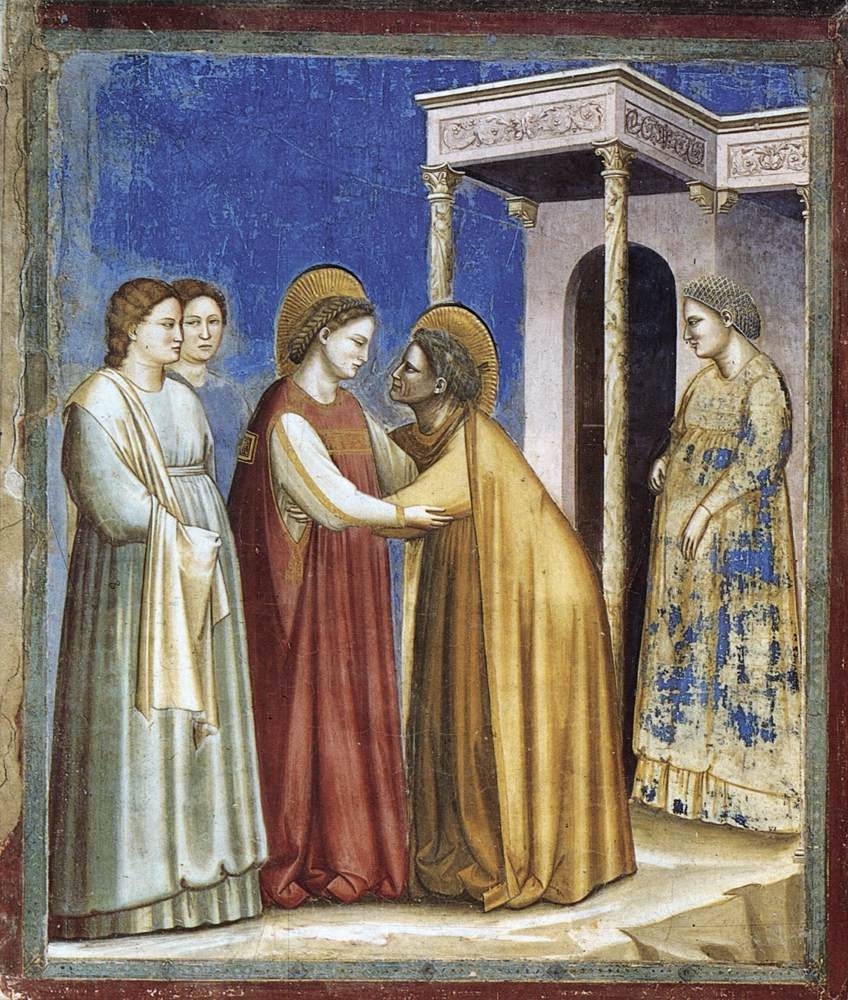
Although it's not written in the text, we can imagine that, being close to her cousin, Mary had been accustomed to coming to Zechariah and Elizabeth's house since childhood, and perhaps even felt a little at home in their home. So she enters their home with familiarity and heads towards Elizabeth, greeting her with a joyful Shalom, Elisabeth, peace be with you, in the Jewish way of saying hello. It's interesting to note the sequence of events: just as the angel entered Mary's home and greeted her, it's Mary's turn to enter Elizabeth's home and greet her. Or going back even further, before having visited Mary, the angel Gabriel had remembered to visit Zacharias... It seems we're going from visit to visit...
At the sight of Elizabeth, Mary seems to me to be triply joyful: joyful to see her beloved cousin, joyful to see her bouncing belly (confirming beyond doubt the sign announced by the angel) and joyful to discover her radiating bliss.
I can't help but draw a parallel here with our sister-Sentinel meetings: there's so much joy in receiving one another, in opening our hearts to one another; our stories light up one another, don't you think?
V. 41 "And it came to pass, when Elizabeth heard Mary's greeting, that the baby leaped in her womb..."
Amazingly, it's Elisabeth who hears, but it's the baby inside her who reacts, and reacts with force, as it's said to leap into her womb.
V. 41 "...and Elizabeth was filled with the Holy Spirit, and she lifted up her voice with a loud cry and said "
Flashback to the announcement made by the angel to Zechariah.
But first, who was Zechariah? Zechariah was a priest. He belonged to one of the 24 priestly classes. His wife Elisabeth was also descended from a famous lineage, that of Aaron.
They were righteous. They observed all the commandments, they were prayerful and yet nothing: they were barren... Like Abraham in his time, he had no descendants despite his faithfulness to God.
It's in this context, as Zechariah is officiating in the temple, that he is visited by the angel Gabriel, who says: "Do not fear for ever, Zechariah, for your prayer has been answered, and your wife Elizabeth will bear you a son, and you will call his name John, and he will bring you joy and gladness, and many will rejoice at his birth. For he will be great in the presence of the Lord, and he will certainly not drink wine or fermented liquor, and he will already be filled with the Holy Spirit". And today, the prophecy is fulfilled. Elisabeth, with a loud cry, begins to speak, her voice gushing forth from deep within her, from her entrails, as if she were the ventriloquist of the Holy Spirit! Surprisingly, while Zechariah became deaf and mute after the announcement, his wife Elisabeth, on the other hand, gave voice: "she lifted up her voice with a loud cry! Funny, the child in her womb is none other than John the Baptist, described as the voice crying out in the desert... Isn't there a connection to be made here... between mother and child? Wouldn't John the Baptist begin his prophetic mission through the mouth of his mother?
Perhaps one of your children has already prophesied in this way?
V. 42 "Blessed art thou among women, blessed also is the fruit of thy womb".
Let's take a moment to imagine what a surprise this must have been for Mary! For Elizabeth to bless her up to that point, ok, but for her to bless her womb! How could she know that she too was expecting a baby, it defies understanding !!!! But now Mary is not out of surprises, for Elisabeth continues.
V. 43 "And from where is this given to me that the mother of my Lord comes to me?"
Frankly, as we contemplate the scene, we can imagine Marie falling head over heels! Her secret, and what a secret it is, so well hidden in her intimacy, bursts into the open! Personally, I marvel at the Lord's thoughtfulness towards Mary. And I can imagine that Mary, too, thanks Him in her heart, overwhelmed by God's thoughtfulness towards her... She doesn't doubt for a moment that it was God who warned Elizabeth of what was happening inside her. She must rejoice inwardly, for she is no longer alone in bearing this prodigious secret; she can share it with her kinswoman, her eldest, in whom she has complete confidence. She is no longer alone; the Lord has given her Elizabeth, and now they can share confidences and marvel together at the Lord's goodness to them and their family. Let's take Elizabeth's side now: how surprised she must have been to hear herself uttering such words, words that spring from her without her fully understanding their meaning, contenting herself with recounting what she observes happening within her; recognizing that this is a gift to her: a gift, and what a gift it is!
Am I also aware that we are gifts to each other? That God has given us each other to help one another, to love one another, to enlighten one another? To grow together? Am I aware that I need the All Other, the other, to discover who I am... What a marvel I am? What a gift I am to others?
V. 44 "For behold, when the voice of your greeting came to my ears, the baby leapt for joy in my womb".
A surprising formulation, don't you think? When the voice arrived, we might have expected when it heard, not when it arrived: Would the voice be a person? A person on the move? A person wishing to speak in our ear? Doesn't that sound familiar? ("Listen Israel, the Lord our God is the only Lord": the first commandment in Jewish law). And it's magnificent, haven't you noticed? Who recognizes who? It's John in Elizabeth's womb, a 6-month-old embryo who "leaps for joy" when he recognizes Jesus, an embryo just a few days old in Mary's womb. The term "leaping for joy" takes us back to an episode from the Old Testament. Remember Samuel 6:16: "King David leaped and twirled before the Lord".
In this way, Elizabeth experienced God. She recognizes a word that comes from afar, touching her in her innermost being. She recognizes Mary as "the mother of her Lord", thanks to the Holy Spirit who interprets in her what is happening. How wonderful! Thanks to the Holy Spirit, she blesses Mary more than herself, and Mary's baby more than her own. And for the first time, she names him.
Elizabeth experiences the presence of the Holy Spirit in her body...
Have you ever experienced the presence of the Holy Spirit in your body? How does it manifest itself?
V. 45 "And happy is she who has believed that there will be a consummation to what is found to have been spoken to her from the Lord".
Here I quote Father Jean Radermakers.
The meeting of the two mothers also reveals the emergence of faith as a beatitude. This beatitude proclaimed by Elizabeth, to be taken up by all generations, (Mary in the Magnificat v.48) is in some way a response to the angel's words announcing Zechariah's silence "since you did not believe" (V.20). Mary enters into the fulfillment of Abraham's faith. Recognizing Mary for what she
is, John's mother allows the austere faith of the Annunciation to blossom into missionary joy.
She who was the only one to say "yes" to the Word of grace and to carry the weight of the world's hope on the road to the land of Judah, discovers in the spiritual sharing of the same faith, the joy of the Magnificat.
Let's take a moment to contemplate the joy of these two women, both filled with grace. The house must be filled with their laughter, their joy overflowing around them to the delight of their household.
Have you ever experienced a "Visitation" in this way? Have you ever had the Lord speak to you through the words of a priest, a Sentinel, a consecrated person, a person on the street...? If so, give thanks to God for the person he has put on your path!
I've often heard it said that Luke's gospel is the gospel of joy; indeed, it begins with a series of announcements, each more joyful than the last, a series of births too, promises of healing...
Intercede Sentinel for our Pope Francis, for the priests of your parish, for the consecrated, for your family, for your friends in suffering, for the people who are put in your path, certain that the Lord is at work today and that through your humble intercession, He is happy to perform miracles, you make His joy by asking Him!
As you meditate on these 7 verses, do you feel the joy welling up within you, dear sister? Take the time to savor these 7 verses, let them echo... And following in Mary's footsteps, sing your magnificat to your God... Exult in God your Savior!
Rejoice, daughter of Zion, and bring blessing around you!
PEACE and JOY.
Charlotte
For the Sentinels of the Holy Family -June 16, 2018